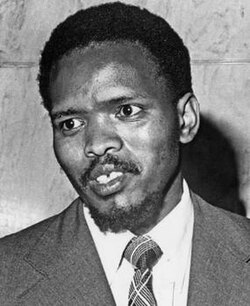
Biography
Introduction: The Voice of Psychological Liberation
Steve Biko† remains one of the most profound and influential figures in the history of South Africa's struggle against apartheid. More than just an activist, Biko was a revolutionary philosopher whose ideas reshaped the psychological and political landscape of resistance. As the principal founder of the Black Consciousness Movement (BCM), his key achievement was instilling a sense of pride, self-worth, and agency in Black South Africans, liberating their minds as a prerequisite for liberating their bodies. His famous assertion, "The most potent weapon in the hands of the oppressor is the mind of the oppressed," encapsulates his life's work. Though brutally killed by the apartheid state at just 30 years old in 1977, Steve Biko's† intellectual legacy became a cornerstone of the anti-apartheid movement, inspiring generations and fueling the final push towards democracy.
Early Life & Education: Forging a Critical Mind
Bantu Stephen Biko was born on December 18, 1946, in King William’s Town, in the Eastern Cape region of South Africa. His early life was marked by both the harsh realities of apartheid and a strong educational foundation. After his father's death, his mother worked as a domestic servant to support the family. A bright student, he attended the prestigious Lovedale Institute, but his education was abruptly interrupted when he and his brother were expelled in 1963 following the arrest of his sibling for alleged anti-government activities.
This early brush with institutional injustice was formative. He later enrolled at St. Francis College, a Catholic boarding school in Natal, where he excelled academically. In 1966, he began studying medicine at the University of Natal's Non-European section, a segregated campus for Black, Indian, and Coloured students. It was here that his political consciousness fully ignited. Frustrated by the white liberal dominance within the multi-racial National Union of South African Students (NUSAS), Steve Biko† argued that Black students needed their own independent organization to articulate their specific struggles and foster self-reliance. This conviction led directly to the founding of the South African Students' Organisation (SASO) in 1968, the vehicle that would launch the Black Consciousness philosophy.
Career & Major Achievements: Architect of a Movement
The career of Steve Biko† was not one of traditional employment, but of relentless activism, writing, and community organization centered on the development and propagation of Black Consciousness.
Founding the Black Consciousness Movement (BCM)
As the first president of SASO, Biko provided the intellectual framework for Black Consciousness. The philosophy sought to:
- Psychological Liberation: Eradicate the inferiority complex internalized by Black people under apartheid.
- Self-Definition: Redefine "Black" as a positive political identity, inclusive of all non-white groups oppressed by apartheid.
- Self-Reliance: Build Black-led institutions and initiatives independent of white liberal control.
- Cultural Pride: Reclaim and celebrate African history and culture.
Through SASO newsletters, community rallies, and his writings under the pseudonym "Frank Talk," Steve Biko† articulated a vision that was radically different from the older, charter-based movements. He argued freedom began in the mind.
Expansion and "Black Community Programmes"
In 1972, Biko was instrumental in forming the Black People's Convention (BPC), a political umbrella organization that spread Black Consciousness beyond campuses into broader communities. That same year, he was expelled from medical school, dedicating himself fully to activism. He worked for the Black Community Programmes (BCP) in Durban, focusing on practical empowerment projects like health clinics (e.g., the Zanempilo Clinic), literacy campaigns, and cottage industries. These projects were tangible manifestations of the self-reliance he preached.
Confrontation with the Apartheid State
The apartheid regime quickly identified Steve Biko† and the BCM as a grave threat. In 1973, he was issued a banning order, severely restricting his movement, speech, and ability to communicate. Confined to his hometown of King William's Town, he was forbidden from writing or speaking publicly, and could not meet with more than one person at a time. Despite this, he continued to organize covertly and advise the movement. The state's repression intensified following the 1976 Soweto Uprising, a watershed protest led by Black Consciousness-inspired students. Biko was arrested and detained multiple times under draconian security laws.
Personal Life, Death & Enduring Legacy
Steve Biko† was known for his charisma, sharp intellect, and compelling oratory. He married Ntsiki Mashalaba in 1970, and they had two children together. He later had two children with Dr. Mamphela Ramphele, a fellow BCM leader and his close collaborator. His personal life was constantly under strain due to state persecution and his total commitment to the struggle.
On August 18, 1977, Steve Biko† was arrested at a police roadblock. He was taken into custody in Port Elizabeth where he endured brutal torture and severe head injuries during interrogation. Denied medical care, he was driven naked and unconscious over 700 miles to Pretoria, where he died alone in a prison cell on September 12, 1977. He was 30 years old. The inquest magistrate infamously ruled that no one was to blame, a decision met with global outrage. His murder galvanized international opposition to apartheid and transformed him into a global symbol of resistance.
Steve Biko's† legacy is monumental. His ideas:
- Directly inspired the student leaders of the 1976 Soweto Uprising.
- Influenced a new generation of activists, including many future leaders of the post-apartheid era.
- Were foundational in the formation of the Azanian People's Organisation (AZAPO) and echoed in later civic movements.
- Are studied globally as a critical framework for understanding race, identity, and liberation psychology.
- Live on through his collected writings, I Write What I Like, and cultural works like the film Cry Freedom and the song "Biko" by Peter Gabriel.
Philosophical Impact & Global Recognition
While not a businessman in the traditional sense, the "value" and impact of Steve Biko's† work are immeasurable. His "venture" was the Black Consciousness Movement, and his "currency" was intellectual and psychological liberation. There is no documented net worth for Steve Biko†; he lived a life of modest means, often supported by the community programs he helped establish. Any financial resources he accessed were channeled directly into the movement and its survival projects, such as the Zanempilo Clinic. His true wealth lies in the enduring power of his philosophy.
Today, Steve Biko† is officially recognized as a martyr in South Africa's liberation history. Numerous institutions, including the Steve Biko Foundation and the Steve Biko Centre in Ginsberg, continue his work of fostering leadership, dialogue, and social change. His grave in King William's Town is a national heritage site. In the realm of Politics & Government, his teachings continue to inform debates on transformation, identity, and true emancipation in South Africa and beyond, securing his place as one of the continent's most significant Liberation & Philosophy thinkers.
Sources and further reading: The Steve Biko Foundation; "I Write What I Like" by Steve Biko; South African History Online; Truth and Reconciliation Commission reports.
Net Worth Analysis
Steve Biko was a political activist who died in 1977 and did not accumulate personal wealth; his legacy is ideological, not financial.
Quick Stats
Related People
Aaron Motsoaledi
LP; Minister of Home Affairs
Abane Ramdane†
FLN Leader & Strategist
Abdalla Hamdok
Ex-Prime Minister
Abdallah Kigoda
Ex-Minister of Natural Resources