Financial Breakdown
Asset Distribution
Assets vs Liabilities
Assets
Disclaimer: These financial estimates are based on publicly available information and should be considered approximate. Last updated: 12/31/2025
Biography
Introduction: A Revolutionary Voice
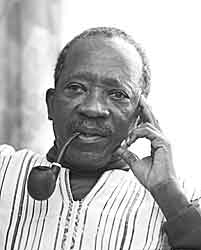
Ousmane Sembène† (1923-2007) stands as a monumental figure in global Arts & Culture, universally acclaimed as the Father of African Cinema. More than just a filmmaker, Sembène was a storyteller, a social critic, and a revolutionary who wielded the camera as a weapon against colonialism, neocolonialism, and social injustice. His key achievement was pioneering a truly African cinematic language, creating films by, for, and about African people at a time when the continent's narratives were overwhelmingly controlled by outsiders. From his first feature, Borom Sarret (1963)—often cited as the first film made by a sub-Saharan African in Africa—to his later masterpieces, Ousmane Sembène† dedicated his life to decolonizing the African mind and giving voice to the marginalized, cementing his legacy as Senegal's and Africa's most influential filmmaker.
Early Life & Education: From Dakar to the Dockyards
Born on January 1, 1923, in Ziguinchor, in the Casamance region of Senegal, Ousmane Sembène's early life was marked by a collision of traditional culture and colonial reality. His formal education was cut short after a controversial incident with a school principal led to his expulsion. This pivotal moment steered him toward the world of manual labor, where he developed a deep connection with the working class—a theme that would dominate his future work. By his late teens, he was in Dakar, working as a fisherman, plumber, and bricklayer.
In 1944, during World War II, he was conscripted into the French colonial army's Senegalese Tirailleurs. After the war, he immigrated to Marseille, France, where he worked as a docker on the bustling port. This experience was profoundly formative. The dockyards were a hotbed of political activism and trade unionism, exposing Sembène to Marxist ideology and pan-African thought. It was here, amidst the struggles of immigrant laborers, that his political consciousness crystallized. Although he lacked formal university training, Sembène educated himself voraciously. He began writing, publishing his first novel, Le Docker Noir (The Black Docker), in 1956, drawing directly from his experiences. His success as a novelist in French established him as a significant literary voice, but he soon realized the limitations of the written word in a continent with high illiteracy rates. This realization would redirect his artistic mission toward the power of the moving image.
Career & Major Achievements: Forging African Cinema
Determined to reach the broadest African audience, Ousmane Sembène† turned to film. In the early 1960s, at the age of 40, he traveled to Moscow to study filmmaking at the Gorky Film Studio under the renowned director Mark Donskoi. Armed with new technical skills, he returned to a newly independent Senegal with a clear mission: to create cinema as a tool for education and liberation.
The Pioneering Films
His directorial debut, the short film Borom Sarret (1963), was a landmark. This poignant 20-minute story of a cart driver's day in Dakar was the first fiction film ever made in sub-Saharan Africa by an African filmmaker. It established his neorealist style and his focus on the everyday heroism of the poor. He followed this with his first feature, La Noire de... (Black Girl, 1966), a devastating critique of postcolonial alienation that won the Prix Jean Vigo, bringing international acclaim to African cinema.
Sembène's career is defined by ambitious, provocative films that tackled Africa's most pressing issues:
- Mandabi (The Money Order, 1968): His first film in his native Wolof language, it was a brilliant satire on bureaucracy and the clash between traditional values and modern capitalist systems.
- Emitaï (1971) & Ceddo (1977): These films directly confronted the history of colonialism and religious imposition. Ceddo was particularly controversial and was banned in Senegal for years.
- Xala (1975): A masterful satire of the African bourgeois elite in independent Senegal, highlighting their corruption and spiritual impotence.
- Guelwaar (1992): A powerful film about religious conflict, examining the tensions between Christians and Muslims through the story of a missing corpse.
The Culmination: Moolaadé
His final film, Moolaadé (2004), is considered one of his greatest achievements. A courageous and vibrant film, it addresses the practice of female genital cutting (FGC). It won the Prix du Jury at the Cannes Film Festival in 2004 and the Best Foreign Film award at the U.S. National Society of Film Critics, proving that Ousmane Sembène† remained at the peak of his creative and political powers well into his seventies. Through these works, he didn't just make movies; he built the very foundation of an independent film industry and aesthetic for a continent.
Personal Life & Legacy: The Enduring Impact
Ousmane Sembène was known for his formidable personality—disciplined, principled, and fiercely dedicated to his ideals. He was a family man, though his primary commitment was always to his art and his political cause. His life was his work, and his work was an extension of his deep love for Africa and its people. He was a mentor to generations of filmmakers across the continent, from Senegal's Djibril Diop Mambéty to Mali's Souleymane Cissé, creating a ripple effect that shaped the course of visual storytelling in Africa.
The legacy of Ousmane Sembène† is immeasurable. He transformed African Arts & Culture by:
- Asserting the right of Africans to tell their own stories on screen.
- Elevating African languages (particularly Wolof) in cinema, making it accessible to local populations.
- Establishing a tradition of socially engaged, politically critical filmmaking that continues to inspire activists and artists globally.
- Winning major international awards that paved the way for global recognition of African cinema.
Net Worth & Business Ventures: The Economy of Principle
Discussing the net worth of Ousmane Sembène† in conventional terms misses the point of his life's work. He operated not within the commercial Hollywood system, but within the context of independent, often politically risky, African film production, which was perennially underfunded. His "wealth" was measured in cultural capital and global influence, not personal fortune. Funding for his films typically came from a patchwork of European television channels (like French and German TV), international film grants, and sometimes from the Senegalese government, albeit with strings attached that often led to censorship battles.
He did not pursue lucrative business ventures or endorsements. His primary enterprise was his production company, which he used to maintain creative control over his projects. Any financial success from his films was reinvested into his next cinematic endeavor. Therefore, while Ousmane Sembène† was not a commercially wealthy individual, his true value lies in the priceless legacy he built: a cinematic corpus that empowered a continent and reshaped global Arts & Culture, making him the richest of figures in the history of African storytelling.
Net Worth Analysis
Ousmane Sembène was a celebrated filmmaker and author, not a business figure; his legacy is cultural, not financial, and he is not on any wealth list.
Quick Stats
Related People
Abasse Ndione
Novelist & Playwright
Abdel Rahman al-Abnudi†
Poet (Egypt-Sudan)
Abdelkrim Ghallab†
Novelist & Journalist

Abdellah Taïa
Novelist & Filmmaker