$5M
Estimated Net Worth
As of 2024 • medium confidence
Financial Breakdown
Asset Distribution
Assets vs Liabilities
Assets
Disclaimer: These financial estimates are based on publicly available information and should be considered approximate. Last updated: 12/29/2025
Biography
Introduction: The Father of the Nation
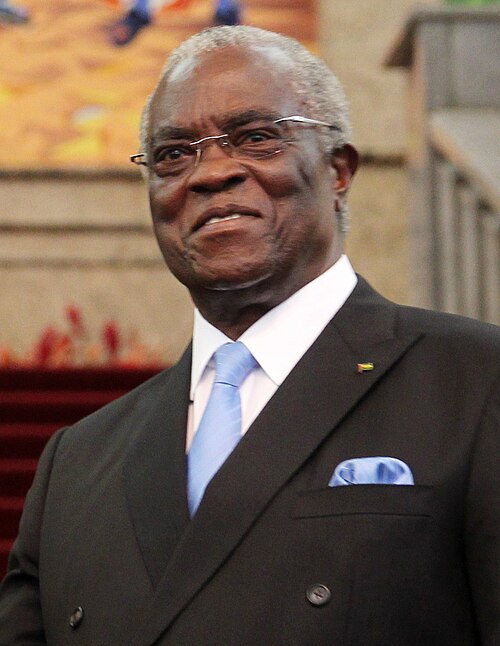
In the annals of African Politics & Government, few figures are as synonymous with their nation's birth as Manuel Pinto da Costa. As the First President & MLSTP Founder of the Democratic Republic of Sao Tome and Principe, Pinto da Costa's legacy is inextricably linked to the country's struggle for sovereignty and its challenging early years as an independent state. A Marxist economist and revolutionary leader, he guided the tiny archipelago from a Portuguese colony to a sovereign nation on July 12, 1975, and presided over its single-party socialist state for nearly 15 years. His tenure, marked by both the consolidation of national identity and significant economic hardship, defines the Independence Era for this island nation in the Gulf of Guinea. This biography explores the life, achievements, and complex legacy of the man who became the principal architect of modern Sao Tome and Principe.
Early Life & Education: Forging a Revolutionary Mind
Manuel Pinto da Costa was born on August 5, 1937, in the capital city of Sao Tome, then part of the overseas Portuguese empire. Growing up under colonial rule, he witnessed firsthand the hierarchical plantation system, known as rogas, which dominated the islands' economy and social structure. This early exposure to colonial inequity planted the seeds of his future political consciousness.
His intellectual prowess earned him the opportunity to pursue higher education in Portugal, a path taken by few Santomeans at the time. He moved to Lisbon in the 1950s, where he studied economics at the prestigious Instituto Superior de Economia e Gestão. It was in the metropole's academic and activist circles that Manuel Pinto da Costa connected with other future African liberation leaders and became deeply immersed in anti-colonial and Marxist ideologies. These formative years were crucial; he helped found the Movement for the Liberation of Sao Tome and Principe (MLSTP) in 1960, alongside other exiles like Miguel Trovoada. The movement's base in neighboring Gabon allowed Pinto da Costa to develop its ideological framework and international alliances, particularly with socialist bloc countries and other liberation movements in Lusophone Africa, setting the stage for a protracted struggle for independence.
Career & Major Achievements: From Liberation to Leadership
The career of Manuel Pinto da Costa is a narrative of revolutionary struggle and nation-building. After the 1974 Carnation Revolution in Portugal, which overthrew the Estado Novo regime, negotiations for decolonization accelerated rapidly. Pinto da Costa, as Secretary-General of the MLSTP, led these talks, culminating in the Alvor Agreement and the peaceful transition to independence on July 12, 1975. He was unanimously elected as the country's First President, a role that combined head of state with significant executive powers.
Founding a One-Party State
Under Pinto da Costa's leadership, the MLSTP established a Marxist-Leninist single-party state aligned with the Soviet bloc and other socialist nations in Africa. His government's major early achievements included:
- Nationalization of the Rogas: The state took control of the vast Portuguese-owned cocoa and coffee plantations, the country's primary economic assets.
- Expansion of Social Services: Significant investments were made in education and healthcare, dramatically increasing literacy and life expectancy from a very low base.
- Development of a National Identity: He fostered a sense of unity and Santomean nationhood distinct from its colonial past.
Economic Challenges and Political Evolution
Despite social progress, the 1980s were marked by severe economic stagnation. The collapse of cocoa prices, management challenges of state plantations, and a centralized economic model led to widespread shortages. By the late 1980s, domestic pressure and the global wave of democratization forced change. In a historic shift, Manuel Pinto da Costa oversaw the introduction of a new constitution in 1990, legalizing multi-party politics. He did not stand in the first free elections in 1991, conceding power peacefully to his former comrade, Miguel Trovoada, an event that solidified the country's democratic credentials.
Return to the Presidency
After a 20-year hiatus from executive office, during which he remained an influential political figure, Pinto da Costa returned to power through the ballot box. Running as an independent but with the support of a coalition, he won the 2011 presidential election, defeating the incumbent. His second non-executive presidency (2011-2016) focused on national unity and managing expectations around nascent oil exploration. However, it was also a period of political gridlock, contrasting sharply with the absolute authority of his first tenure.
Personal Life, Legacy & Lasting Impact
A private and intellectual figure, Manuel Pinto da Costa is known for his scholarly demeanor. He is fluent in Portuguese, French, and German, the latter stemming from his academic work and studies in East Germany. He was married to Maria Amelia Pinto da Costa, who served as First Lady during his terms. His personal interests have long centered on economic theory and development studies, reflecting his academic background.
The legacy of Manuel Pinto da Costa is multifaceted. He is revered as the indispensable Independence Era leader who shepherded Sao Tome and Principe to nationhood and built its foundational institutions. Critics point to the economic hardships and political repression during his first, single-party rule. Nevertheless, his ultimate decision to peacefully dismantle the one-party system and accept electoral defeat is a pivotal part of his legacy, credited with helping usher in a stable, democratic tradition in the country. His life embodies the journey of a generation of African leaders who fought for independence, grappled with the immense challenges of post-colonial governance, and, in his case, ultimately acquiesced to democratic change.
Net Worth & Business Ventures
As a lifelong politician and civil servant who led a nation with one of the world's smallest economies, Manuel Pinto da Costa is not associated with significant personal business ventures or substantial private wealth accumulation, especially during his Marxist-oriented first presidency. His career was dedicated to public service and political leadership. Unlike some leaders, his financial profile is not defined by private enterprise but by state salary and pensions. Any assessment of his net worth would be speculative, as no credible public disclosures exist. His "wealth" is more accurately measured in political capital and his enduring status as a founding father. In his later years, his financial standing would be consistent with that of a former head of state from a developing nation, reliant on official pension and potentially income from writings or speeches. The focus on Manuel Pinto da Costa remains firmly on his political impact, not financial portfolio, aligning with the socialist principles he long advocated for Sao Tome and Principe.
Sources: Historical accounts of Sao Tome and Principe's independence are documented by scholars like Gerhard Seibert. Key events are recorded in official state archives and through reports from international bodies like the UN and the African Union. Further context on Lusophone African liberation movements can be found in academic works on post-colonial Politics & Government.
Net Worth Analysis
As a former president of a small, low-income nation with no known major business interests or inclusion on any billionaire list, his wealth is estimated based on his political career and public service.
Quick Stats
Related People
Aaron Motsoaledi
LP; Minister of Home Affairs
Abane Ramdane†
FLN Leader & Strategist
Abdalla Hamdok
Ex-Prime Minister
Abdallah Kigoda
Ex-Minister of Natural Resources