Biography
Introduction: A Founding and Controversial Figure
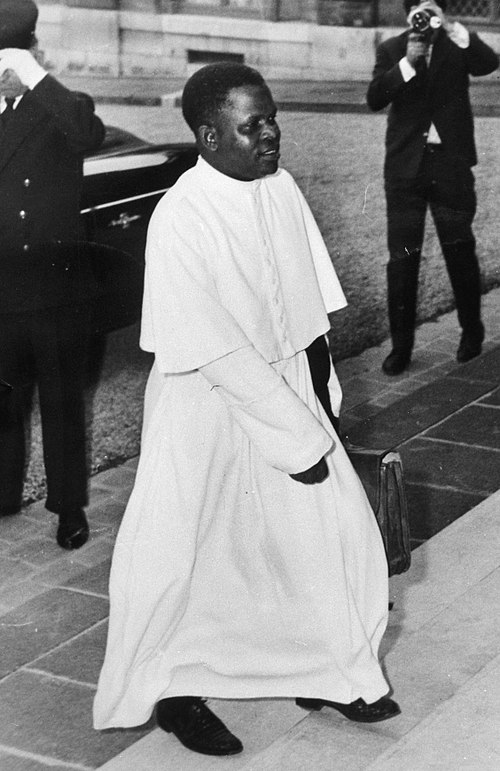
In the annals of Politics & Government in Central Africa, few figures are as pivotal and polarizing as Fulbert Youlou†. As the First President of the newly independent Republic of the Congo (often referred to as Congo-Brazzaville), Youlou stands as a foundational architect of the nation's post-colonial journey. A former Catholic priest turned politician, he led the country to independence from France on August 15, 1960, and served as its head of state from 1959 until his dramatic ouster in 1963. His tenure, though brief, was marked by ambitious visions for pan-African unity and economic modernization, but also by increasing authoritarianism, ethnic favoritism, and severe political strife. This biography explores the life and legacy of Fulbert Youlou†, a man whose clerical collar and political ambition became symbols of the turbulent Independence Era.
Early Life & Education: From Seminary to Priesthood
Fulbert Youlou† was born on June 9, 1917, in Madibou, a village in the Pool region near Brazzaville, within what was then French Equatorial Africa. He was a member of the Lari ethnic group, a detail that would profoundly influence his political base and later conflicts. From a young age, he was directed toward a religious life. His early education took place in Catholic missionary schools, showcasing his intellectual promise. He pursued theological studies at seminaries in Akono (Cameroon) and Yaoundé, and was eventually ordained as a Catholic priest in 1946.
His formative years as a priest, however, were unconventional. Fulbert Youlou† was known for his charismatic preaching and his keen interest in social and political matters, which often placed him at odds with his ecclesiastical superiors. He served in the Brazzaville suburbs, where he cultivated a strong, devoted following among the Lari and Bakongo communities. This period was crucial; it was here that he built the grassroots network and populist appeal that would become the bedrock of his political career. His ability to blend spiritual authority with emerging nationalist sentiment set the stage for his dramatic entry into the secular arena of Politics & Government.
Career & Major Achievements: Priest, Politician, President
The political ascent of Fulbert Youlou† was rapid and groundbreaking. In 1956, defying church directives that forbade clergy from political engagement, he entered the electoral fray. He founded the Union Démocratique pour la Défense des Intérêts Africains (UDDIA), a party championing independence and close ties with France. His clerical attire became his trademark, earning him the nickname "the priest in a sarong." In 1956, he was elected Mayor of Brazzaville, and in 1958, he played a key role in the referendum that established the Republic of the Congo as an autonomous republic within the French Community.
The Path to Independence and Presidency
Following political maneuvering and coalition-building, Fulbert Youlou† became Prime Minister in November 1958. His crowning achievement came on August 15, 1960, when he formally proclaimed the full independence of the Republic of the Congo, with himself as its first President. As a leader, Youlou advocated for a moderate, pro-Western path and was a prominent proponent of pan-African cooperation. He, along with figures like Felix Houphouët-Boigny, was instrumental in forming the Brazzaville Group of states, which stood in contrast to the more radical Casablanca Group. This bloc later evolved into the Organization of African Unity (OAU).
Economic Policies and Growing Dissent
Domestically, President Fulbert Youlou† pursued policies aimed at economic liberalization and attracting foreign investment. He sought to modernize infrastructure and maintain strong economic links with France. However, his administration became increasingly characterized by a concentration of power. In 1961, he pushed through a new constitution that established a presidential system, and he was subsequently elected president with a claimed 99% of the vote. His rule was perceived as favoring his Lari ethnic base, leading to tensions with other groups, particularly the Mbochi and the influential trade union movement, which was rooted in the socialist and anti-colonial ideologies popular among the Congolese youth and intelligentsia.
The "Trois Glorieuses" and Downfall
The culmination of this discontent was the Trois Glorieuses (Three Glorious Days) of August 13-15, 1963. Widespread strikes and protests, primarily led by trade unions and students, erupted in Brazzaville. The demonstrations, triggered by economic grievances and political repression, quickly escalated. Key institutions, including the army and civil service, withdrew their support. On August 15, 1963—exactly three years after independence—Fulbert Youlou† was forced to resign. He was subsequently arrested and imprisoned, marking a violent end to the Congo's first experiment in republican government.
Personal Life, Exile, and Legacy
The personal life of Fulbert Youlou† was a source of controversy that fueled his critics. As a celibate priest, his private affairs were scrutinized, and rumors about his conduct circulated widely, damaging his moral authority. Following his ouster, he lived in exile, first in the Democratic Republic of the Congo and later in Spain. Fulbert Youlou† died on May 6, 1972, in Madrid, at the age of 54.
The legacy of Fulbert Youlou† is complex and contested. He is undeniably the father of Congolese independence, the man who formally severed colonial ties. His advocacy for African unity on the continental stage remains a noted part of his record. However, his legacy is overwhelmingly shadowed by his authoritarian tendencies, the ethnic polarization that intensified under his rule, and his ultimate failure to create stable, inclusive governance. His downfall opened the door to a series of military regimes and a declared Marxist-Leninist state, setting a pattern of political volatility. Today, historians view Fulbert Youlou† as a quintessential figure of the early Independence Era: a leader who successfully navigated the transition from colony to nation but could not overcome the profound challenges of building a democratic and unified state.
Net Worth & Business Ventures
Quantifying the net worth of historical political figures like Fulbert Youlou† is challenging due to a lack of transparent financial records from the period. As the First President of the Republic of the Congo, he controlled state resources and oversaw an economy still largely managed in conjunction with French interests. While there is no documented evidence of vast personal business empires on the scale of later African leaders, accusations of corruption and personal enrichment were central to the grievances that led to his 1963 overthrow. Protesters and critics alleged that his administration engaged in nepotism and that the benefits of economic policies disproportionately favored his inner circle and ethnic allies. His primary "venture" was the state itself, and his political capital was intrinsically linked to his control over the nascent nation's institutions and its patronage networks. After his fall from power, he lived in exile without access to state resources, and there are no reports of significant personal wealth or commercial holdings at the time of his death in 1972.
Key Facts and Timeline
- Birth: June 9, 1917, Madibou, French Equatorial Africa.
- Ordination: Became a Catholic priest in 1946.
- Political Founding: Founded the UDDIA political party in 1956.
- First Elected Office: Elected Mayor of Brazzaville in 1956.
- Prime Minister: Assumed the role in November 1958.
- Independence: Proclaimed President of the independent Republic of the Congo on August 15, 1960.
- Major Policy: Leader of the pro-Western "Brazzaville Group" in pan-African politics.
- Downfall: Forced to resign on August 15, 1963, during the "Trois Glorieuses" uprising.
- Death: May 6, 1972, in Madrid, Spain.
For further reading on this era, credible sources include the Encyclopædia Britannica and academic works on post-colonial African Politics & Government.
Net Worth Analysis
Fulbert Youlou died in 1972 and was a priest and politician, not a business figure; there is no credible source attributing a significant personal fortune to him.
Quick Stats
Related People
Aaron Motsoaledi
LP; Minister of Home Affairs
Abane Ramdane†
FLN Leader & Strategist
Abdalla Hamdok
Ex-Prime Minister
Abdallah Kigoda
Ex-Minister of Natural Resources