$5M
Estimated Net Worth
As of 2024 • medium confidence
Biography
Introduction: The Bulldozer of Bissau Politics
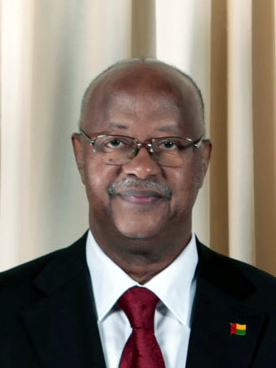
Carlos Gomes Júnior, widely known by his nickname "Cadogo," is a towering and often polarizing figure in the Politics & Government landscape of Guinea-Bissau. Born in 1949, his life has been inextricably linked with the nation's turbulent journey from liberation struggle to fragile democracy. A stalwart of the African Party for the Independence of Guinea and Cape Verde (PAIGC), the party that led the country to independence, Gomes Júnior ascended to the pinnacle of power, serving as Prime Minister on two separate occasions. His most notable achievement was overseeing a period of relative stability and economic reform in the late 2000s, culminating in his advancement to the presidency as the PAIGC candidate in the 2012 elections. However, his career was dramatically interrupted by a military coup just days before the presidential run-off, an event that underscores the persistent tension between civilian and military power in Guinea-Bissau and defines his legacy as a key figure in the Opposition and national politics.
Early Life & Education: Forging a Path in a Nascent Nation
Carlos Gomes Júnior was born in 1949 in the then-Portuguese colony of Guinea. His formative years coincided with the escalating armed struggle for independence led by the PAIGC, founded by Amílcar Cabral. This revolutionary environment profoundly shaped his political consciousness. Unlike many of the independence era's guerrilla leaders, Gomes Júnior's path was oriented toward economics and administration, reflecting the PAIGC's need for nation-builders alongside military commanders.
He pursued higher education in banking and finance, studying at the Instituto Superior de Economia e Gestão in Lisbon, Portugal. This technical background set him apart, equipping him with skills focused on economic governance rather than military strategy. After Guinea-Bissau achieved independence in 1974, the new nation faced the immense challenge of constructing a functional state apparatus. Young, educated professionals like Carlos Gomes Júnior were urgently needed. He quickly entered public service, initially within the country's financial and banking sector. His early career was spent in institutions like the Banco Nacional da Guiné-Bissau, where he honed the expertise in fiscal and monetary policy that would later define his tenure as Prime Minister. This technocratic foundation, built within the single-party framework of the PAIGC, positioned him as a modernizer within the party ranks.
Career & Major Achievements: From Technocrat to Prime Minister
The political career of Carlos Gomes Júnior is a chronicle of Guinea-Bissau's rocky transition to multi-party democracy. He held several ministerial positions before his first appointment as Prime Minister in 2004 under President Henrique Rosa. However, his most impactful period began with his second term as Prime Minister in 2009, following the PAIGC's victory in parliamentary elections.
Prime Ministerial Tenure and Economic Reforms
From 2009 to 2012, Gomes Júnior led the government during a period marked by both progress and profound crisis. His administration, backed by a stable parliamentary majority, embarked on a series of reforms aimed at stabilizing Guinea-Bissau's economy. Key initiatives included:
- Implementing structural adjustment programs in agreement with the International Monetary Fund (IMF) and World Bank.
- Cracking down on corruption and drug trafficking, which had severely tarnished the country's reputation as a "narco-state."
- Attempting to reform the powerful and politically meddlesome military.
The 2012 Presidential Bid and Military Coup
Following the death of President Malam Bacai Sanhá in January 2012, Carlos Gomes Júnior became the PAIGC's presidential candidate. He led the first round of voting in March 2012 but failed to secure an outright majority, forcing a run-off against former President Kumba Ialá. On April 12, 2012, just days before the second round, soldiers stormed his residence, arresting him and the interim president. This military coup abruptly ended the electoral process and forced Gomes Júnior into exile for over two years. The coup was widely interpreted as a move by military factions threatened by his reform agenda and his pledge to investigate the armed forces' alleged ties to drug cartels. This event remains the central, defining rupture in his political life.
Return and Role in Opposition
After returning from exile in 2014, Carlos Gomes Júnior re-entered the political fray, but his dominance within the PAIGC had waned. Internal party divisions led to his departure from the PAIGC in 2016. He subsequently formed his own political party, the Partido da Convergência Democrática (PCD), positioning himself firmly in the Opposition. While his influence as a national kingmaker has diminished, he remains a vocal critic of the government and a symbol of civilian political ambition that clashed directly with military interests.
Personal Life & Legacy: The Lasting Impact of "Cadogo"
Outside of the intense world of Guinea-Bissau politics, Carlos Gomes Júnior is known to be a private individual. His public persona is almost exclusively that of a determined and resilient politician. His legacy is complex and subject to intense debate. To his supporters, he is a champion of economic reform and civilian rule who was unjustly prevented from leading the country. To his detractors, he is an authoritarian figure whose confrontational tactics contributed to political instability.
Regardless of perspective, his impact is undeniable. The 2012 coup that targeted him highlighted the fundamental challenge of civil-military relations in Guinea-Bissau. His career trajectory—from PAIGC technocrat to reformist Prime Minister to coup victim and opposition leader—mirrors the nation's own struggles with democracy, institutional weakness, and external shocks like the drug trade. As an Ex-PM & PAIGC Leader, Carlos Gomes Júnior's story is essential to understanding the post-independence political history of Guinea-Bissau. He demonstrated that a civilian leader could, for a time, challenge entrenched military and criminal interests, and his removal underscored the high costs of doing so.
Net Worth & Business Ventures
Specific details regarding the net worth of Carlos Gomes Júnior are not publicly disclosed, which is common for many political figures in Guinea-Bissau. His known career has been almost entirely within the public sector, from his early days in the national bank to his high-ranking government positions. Unlike some regional politicians, there is no widespread public record or evidence of significant private business ventures or substantial wealth accumulation directly tied to him. His financial profile appears to be primarily linked to his long-term political salary and pensions. In the context of Guinea-Bissau's economy, which is one of the world's least developed, the wealth of even its most prominent politicians is not comparable to that of business leaders in more stable economies. The primary "currency" of his career has been political influence rather than overt private commercial enterprise.
Net Worth Analysis
As a former Prime Minister and political leader in Guinea-Bissau, a low-income country, his wealth is likely derived from a public salary and political career, not major business holdings. He is not listed on any international wealth index.
Quick Stats
Related People
Aaron Motsoaledi
LP; Minister of Home Affairs
Abane Ramdane†
FLN Leader & Strategist
Abdalla Hamdok
Ex-Prime Minister
Abdallah Kigoda
Ex-Minister of Natural Resources